A founder in Nigeria wrote this about buyers
“Trust is gone.”
Your buyers ask the price and ghost you. Or they will only pay on delivery.
If that sounds like your week, your last 10 chats can show you where those buyers stopped: at your ad, your page or your offer. You’ve never met me either, so the first check is free on this page, before you pay anything. The other five are in the book.
See the free checkSix checks, in a PDF made for your phone, that opens the moment you pay. You pay on Selar, by card or bank transfer, and it comes with the keep-the-book promise: 30 days to ask for your money back, and you keep the book.
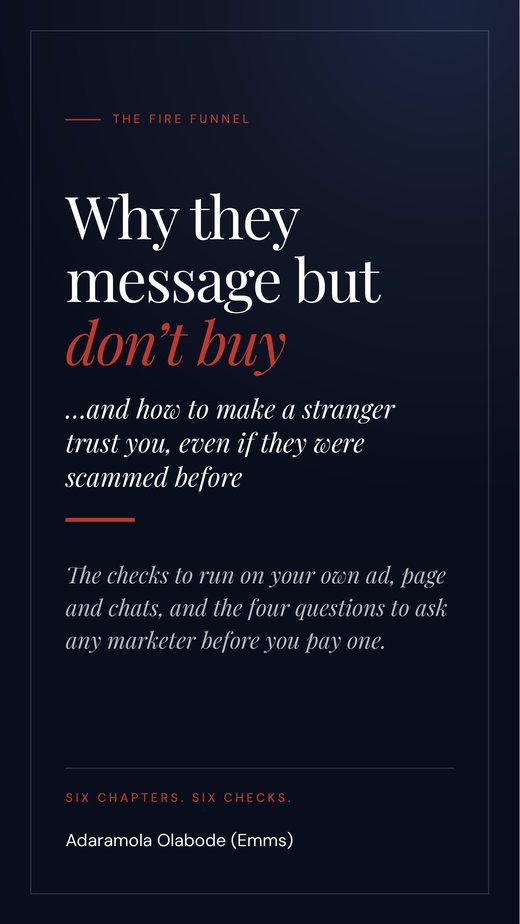

From Emms (Adaramola Olabode), the-fire-funnel.com. WhatsApp +234 810 305 8141.
The problem
Pay on delivery, and still begging
The founder’s full post:
“Na why my customers no dey gree do prepaid anymore. They all want pay on delivery . And it hurts my business too. How can I waybill item to you from Lagos to South South and I’m still begging you to come and pick and pay for what you ordered? Trust is gone.”
If you’ve sent a waybill and then waited for a buyer to come and pick, you know every word of that.
Or maybe your week goes like this: the ad goes live, messages come in, someone asks “Price?”, you reply, and then nothing.
“customers just ask the price and then go onto ghost mode”
“I have tried POD on mine but Nigerians are moving funny with POD now and it’s crazy”
And all that time, your ad money is leaving your account every day. When a pay-on-delivery order goes wrong, you’re the one who pays the waybill and waits.
Buyers do have a reason for this, and it makes sense once you look at the chat from their side.
Why buyers do it
Read the chat from the other side
Your buyer saw your ad, but they’ve never met you and never touched your product. To them, you’re a name and a picture on a phone, asking them to send money to an account.
“somebody has scammed them before”
A buyer who’s been burned before uses pay on delivery to move the risk to you, so if nothing comes, they lose nothing. They’re protecting themselves from the last seller who took their money, and you end up paying for what that seller did.
When a buyer asks for pay on delivery, something in your ad, page or chat hasn’t given them enough reason to trust you yet.
A founder who sells male wears, wholesale and single, posts his goods at a low price. He wrote that buyers check his prices and “will attribute it to fake bcus of the price.” Then they “end up buying that same item twice the price from a dropshipper or boutique owner that bought from me”
So the same item wasn’t believed from him at half the price, but it was believed from a reseller at double. Only two founders behind this book wrote about this, so treat it as something to check in your own chats, not as a rule.
You can’t make a buyer pay first, but you can look at what they see before they decide.
I can show you what a stranger needs to see before they believe you’re real and the product is what the ad shows.
When sales don’t come, you look for a reason, and founders name the ones they can see from where they stand.
“Facebook and Instagram ads has punished me”
“My village people are following me oo”
I understand why. Facebook is where the money went, so it’s the first thing you suspect. And sometimes the cause really is outside: if your account was banned or a payment for ads failed, this book can’t fix that.
But think about the other weeks, when the account was fine, the card went through, the ad ran, and some of the people who saw it messaged you.
Something happened between them seeing the ad and paying, and it happened in one of three places you control.
How the book works
The three places a stranger decides about you
The ad. What they saw before they messaged or clicked.
The page. What they saw before the pay button. If you sell in WhatsApp, your catalogue and your first replies do this job.
The offer. The price, the delivery cost, when they pay, and what happens if it goes wrong.
You can look at each of these today yourself, without paying anyone, and if the cause is in one of them, you can find it.
The book walks through each one the way a buyer who has never met you sees it. Each chapter ends with one check, done on what you already have: your chats, your last ad, your page and your offer, and in chapter 6, any marketer you are about to pay.
Free, from the book
The first check is free. Do it tonight.
Free, from the book
This is the check from chapter 1, as it is in the book. It is free so you can judge the book on your own chats before you pay for it.
Open WhatsApp, or your DMs, or wherever your ad sends people. Scroll to the last 10 people who asked about a product. Include the ones who bought.
Next to each one, write one mark:
- 1Asked the price and went quiet.
- 2Wanted pay on delivery.
- 3Went quiet after you sent details.
- 4Bought.
If a chat fits none of these, copy the buyer’s last message word for word. Their exact words are worth more than your summary of them.
Count the marks and write the four numbers down. Chapters 2, 4 and 5 use them.
If your ad brought fewer than 10 enquiries, use all you have. That count tells you something too.
Your biggest number tells you where to go next. Price and quiet: chapter 3, then chapter 5. Pay on delivery: chapter 2, then chapter 5. Quiet after details: chapter 4.
If most of them bought, your ad, page and offer are doing their job with the people who reach you. Read on anyway. Chapter 6 is for the day you hire help.
That’s one check out of six. The other five show you what to look for in each place, and what to fix first.
Right now you’re the buyer, reading a page from someone you’ve never met. So before you trust my checks, you should know who I am and what I can’t show you.
Who wrote it
Who I am, and what I won’t claim

Adaramola Olabode (Emms)
Full funnel copywriter and creative strategist · the-fire-funnel.com
I’m Adaramola Olabode, Emms. I’m a full funnel copywriter and creative strategist: I write ads, product pages and emails for brands that sell online. I live and work in Osun State, Nigeria.
Before I write a word for any brand, I look for where buyers stopped. My own rule, from my site: “The work does not start until the problem is found.”
For one home decor brand’s cart emails, the store’s own data showed “64% of carts abandoned at the shipping calculation”. Those buyers wanted the product, but one number on the screen stopped them. So the emails were written for that moment, and the discount was held back until the last of the three.
64%
of carts abandoned at the shipping calculation
One home decor brand’s own data.
I once rewrote a product page for a furniture brand selling a chair online. Buyers couldn’t sit in the chair before paying for it, so the page had to tell them what sitting in it would have.
Your buyer has the same problem with your product. They can’t touch it, so everything they believe about it comes through a screen.
A skincare client wrote this to me about ad copy I wrote for them:
... 2,800 bottles sold in 60 days from one ad and the anti-aging hook stopped people exactly like you said it would.
That’s a result from someone else’s business, the kind chapter 6 tells you to be careful with.
None of these three brands is African, and none of my client work so far has been for an African brand. I’d rather you hear that from me now than find out later.
So judge this book the way chapter 6 asks you to judge anyone you pay.
No reviews yet
The book, put through its own four questions
Chapter 6 gives you four questions to ask anyone before you pay them. This book answers them about itself.
What did I look at before writing it?
Public posts and comments by African founders and buyers from 2024 to 2026, and my own client files.
What was the thinking behind one piece of it?
The first check asks for your last 10 enquiries because every chat that ended without a payment stopped somewhere. Where it stopped tells you which place to look at first. It’s the same habit I used with the decor brand’s data: find where people stopped before you change anything.
Where do the words come from?
Every founder quote in it is copied as the founder wrote it, spelling and all, and never reworded. Between them, 32 founders named five things buyers look for before they trust a seller online, and chapter 2 is built on their words.
What do you receive, and by when?
The book and its checks, as a PDF, the moment you pay. The book promises no result.
The book is new, so nobody has reviewed it yet and there are no reviews on this page. When buyers send me their words and say I can use them, I’ll put them here.
Until then, judge it by the free check from chapter 1. You can run it on your own chats tonight.
What changes
The next “Price?”, answered in one reply
Picture the next buyer who sends one word: “Price?”
One seller in chapter 4 replies: “It is available. Where are you located?” The buyer answers, then the price comes, then the account number, and the buyer goes quiet.
This time your first reply has the price and the delivery cost, a photo of orders packed that morning, one screenshot of a buyer saying theirs arrived, and the name on the account. A stranger can check you from the very first message.
That reply is in chapter 4, and the checks show you which parts of it your page is missing and what to fix first.
Inside
What the book shows you
- Why reviews on your website do nothing for a buyer who only ever sees your ad and your chat. Chapter 2
- What a photo of packed orders on your floor tells a stranger about you. Chapter 2
- The one doubt every product carries, and where to find yours: in the question buyers ask before they go quiet. Chapter 3
- Why the price belongs in your ad: each “Price?” that goes quiet cost you a conversation. Chapter 3
- What to say before you send the account number. Chapter 4
- Why one seller’s item was not believed at half the price, and was believed from a reseller at double. Chapter 5
- What “No refund after payment” tells a buyer who was scammed before. Chapter 5
- The two red flags in a marketer’s pitch, and the four questions to send before any payment. Chapter 6
Contents
What is inside: six chapters, six checks
The book is called “Why they message but don’t buy”. Chapters 1 to 5 are about your own ad, page and offer. Chapter 6 is for the day you hire help.
- →
How to use this book.
Who it’s for, what it won’t do, and where you start. If your buyers won’t pay before delivery, it sends you to chapter 2.
- 1
“I have ran ads but no sales”.
Where to look for the cause, the three places you control, and the check on your last 10 enquiries.
- 2
“Trust is gone.”
The other side of the chat, and the five things buyers look for before they trust a seller online.
- 3
The ad: “price it and video it”.
Four yes-or-no questions to put to your last ad.
- 4
The page: “i need my customer trust”.
What a buyer has to see before the pay button or the account number.
- 5
The offer: “she wanted payment on delivery”.
Who carries the risk, a price that reads as fake, a cost that appears late, and one refund term said the same way everywhere.
- 6
“I am not paying in advance for anything.”
What to see before you pay a marketer, and two red flags.
- ✓
The checks on one page,
made to screenshot. Do the checks in order the first time.
Every chapter title quotes a founder. The book is a PDF made for your phone, about 6,500 words, roughly half an hour of reading.
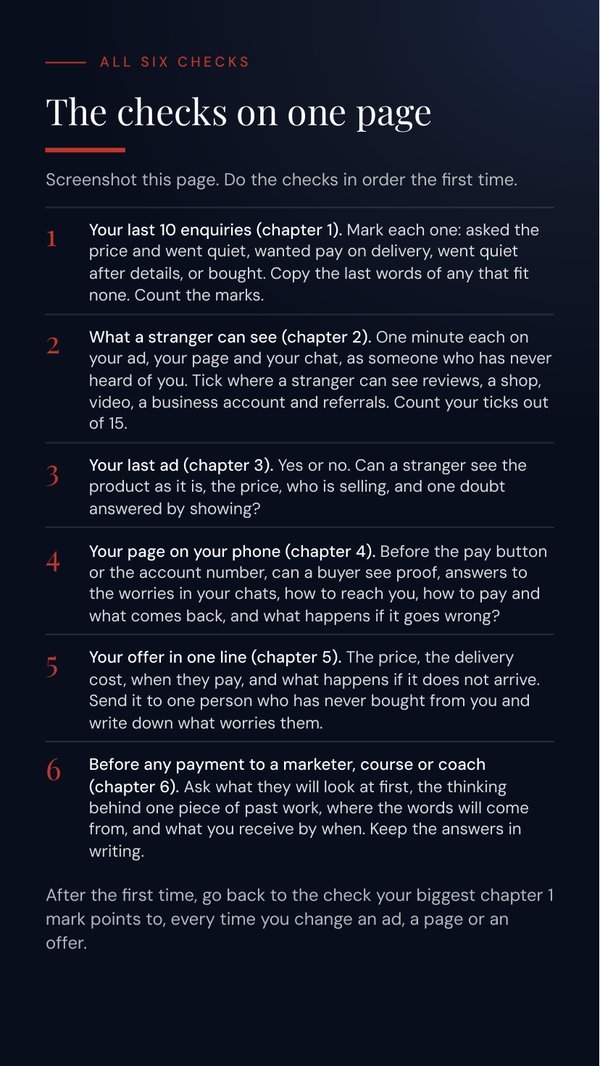
The checks on one page, as it looks on your phone. Screenshot it and keep it.
The price
What it costs, and why
Every job I take starts the same way: finding what’s stopping people from buying. The checks are that step, written down so you can do it yourself.
You do the looking yourself, with the checks, on your own ad, page and chats. I never see your business and I don’t write anything for you, which is why the price is low, and in naira for founders in Nigeria.
For a sense of size: one founder in this book named an ad budget of ₦3,000 to ₦4,000 a day. A week of that is ₦21,000 to ₦28,000, and the book costs less than two days of it.
₦21,000 to ₦28,000
One week of one founder’s ad budget
₦4,999
The book, paid once
Put ₦4,999 beside what your own ads cost you last week. If you want the other five checks before your next ad goes live, tap the button below.
₦4,999, paid once on Selar, by card or bank transfer.
Why they message but don’t buy
PDF for your phone · 6 chapters · 6 checks · about 6,500 words
Your download opens the moment you pay. Card, or a transfer to an account named SELAR. 30 days to ask for your money back, and you keep the book. Questions first? WhatsApp +234 810 305 8141.
Questions
Fair questions before you pay
“Another person selling me a PDF?”
Yes, it is. A founder in Ghana wrote about people who sell ads advice: “They’ll say that and try to sell you a course.” That’s why the book tells you to put anyone selling to you through its four questions, this book included. This page answers them about the book, and you can check the answers against what you get.
“Can I pay after I read it?”
You can’t send a PDF back once it’s on your phone, so pay on delivery can’t work for it. Instead, you get the first check from chapter 1 free on this page, before you spend anything, and then 30 days to ask for your ₦4,999 back, and you keep the book.
“Will it work for what I sell?”
Every check uses what you already have: your last ad, your product page or catalogue, and your WhatsApp and DM chats. The book’s own examples include a hair oil, a body cream, clothes, a generator and male wears. It’s written for founders in Nigeria first. If you sell from Ghana, Kenya or South Africa, the checks still work on your own ad, page and chats. If you haven’t started selling yet, or you sell a digital product, the checks won’t have much to work on.
“Nothing fixes Nigerian buyers.”
The male wears seller’s buyers did pay, at double the price, to a reseller they believed. The book doesn’t promise you prepaid orders. It shows you what a stranger can see of you before they decide. Whether they pay first is up to them, but you can make sure the doubt isn’t coming from something you left out.
“Is this going to try to sell me more?”
Yes, a little, and I’d rather say so. At ₦4,999 the book reaches a lot of founders, and some of them will want more help from me later. There’s an optional apply-it pack: the check sheet with boxes to fill in, six copy-and-fill templates and the marketer message, for ₦3,999. The book is complete without it.
The book’s last page names one next step, once. It’s the 5-Day Funnel Fix: five days in a group doing these checks on your own business, with my written feedback. It runs on set dates, and its own page gives the price.
After you buy, I email you to help you use the book. Some of those emails, once you’ve had time with it, invite you to the 5-Day Funnel Fix. Every email has an unsubscribe link, and I don’t message you on WhatsApp unless you message me first.
“When will I find the time?”
The book is roughly half an hour of reading. The first check needs your chats and a pen.
Why they message but don’t buy
PDF for your phone · 6 chapters · 6 checks · about 6,500 words
Your download opens the moment you pay. Card, or a transfer to an account named SELAR. 30 days to ask for your money back, and you keep the book. Questions first? WhatsApp +234 810 305 8141.
Before your next ad goes live
You might have felt for weeks that something between the ad and the payment is off. Every day your ad runs, new people see the same ad, page and offer, so if their doubt starts in one of those places, it’ll start there again tomorrow, and you’ll pay for it again. The free check on this page tells you where to look, and the other five show you what to look for and what to fix first. Get them before you pay for another day of ads.
The guarantee
The keep-the-book promise
Use it for 30 days. If you want your money back, for any reason, message me on WhatsApp or reply to the email the book came with, and I send back your ₦4,999 within 3 days. You keep the book.
One message is enough. There’s no form to fill.
I can offer this because one evening is enough to tell whether the checks fit your business. Chapter 1’s check turns your last 10 chats into four numbers and tells you which chapter to read next.
So all you’re risking is one evening with your own chats, and you have my word on the refund. The refund terms are on the Selar page too, so you can read them before you pay.
How to buy
How to get it, step by step
- 1Tap “Get the book for ₦4,999”. Selar opens on the book’s page, “Why they message but don’t buy”. Selar is the checkout I use.
- 2Pay by card or by bank transfer. If you choose transfer, Selar shows you an account number made for your order, and the account name is SELAR. Selar checks the transfer by itself and opens your download. If the amount is wrong, Selar rejects it and sends it back within 24 hours.
- 3Your download opens straight away. Selar also emails you the link, and I send you a welcome email.
- 4If you’ve paid and the download hasn’t opened, or anything doesn’t arrive, message me on WhatsApp at +234 810 305 8141 or email emms@the-fire-funnel.com. I reply within 24 hours.
Paying someone you’ve never met online is exactly the worry this book is about, so the first check is free, you pay through Selar, transfers go to an account named SELAR, and you have 30 days to ask for your ₦4,999 back.
Why they message but don’t buy
PDF for your phone · 6 chapters · 6 checks · about 6,500 words
Your download opens the moment you pay. Card, or a transfer to an account named SELAR. 30 days to ask for your money back, and you keep the book. Questions first? WhatsApp +234 810 305 8141.
Last word
Who this book is for, and who it isn’t for
It’s not for founders who haven’t started selling yet, or for digital product sellers. It doesn’t cover banned ad accounts, banned WhatsApp numbers, or cards that keep getting declined, and it doesn’t teach targeting, budgets or reading Ads Manager. If that’s your week, this is the wrong book, and you should keep your ₦4,999.
It’s not for anyone who wants a promise of sales. I haven’t seen your ad, your page or your numbers, and anyone who promises sales without seeing them is guessing.
You sell a product online and you’ve run ads. Maybe the sales didn’t come the way the spend said they would, or buyers came but wouldn’t pay first, or you’re about to pay someone to run your ads. If any of that is you, this book was written for you.
If you’d rather just tell me what your checks found, message me on WhatsApp at +234 810 305 8141. I reply within 24 hours.
Emms
P.S. The founder who wrote “Trust is gone.” was sending waybills and then begging buyers to come, pick up and pay. The free check on this page shows you where your own buyers stop, and the other five are in the book for ₦4,999. You get 30 days to ask for your money back, and you keep the book either way.
Why they message but don’t buy
PDF for your phone · 6 chapters · 6 checks · about 6,500 words
Your download opens the moment you pay. Card, or a transfer to an account named SELAR. 30 days to ask for your money back, and you keep the book. Questions first? WhatsApp +234 810 305 8141.